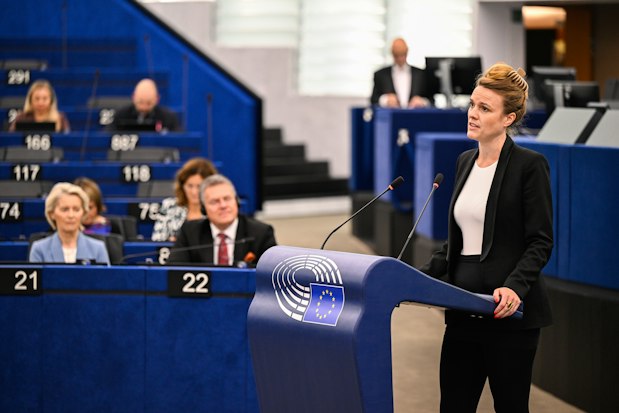
European Commission President Ursula von der Leyen used her State of the Union address to launch the European election campaign. But she remained silent on two crucial questions. How will she protect European democracies from the threat of the far right? And will the European People's Party - her party - fully back her promises to stay the course on an ambitious Green Deal?
"In just under 300 days, Europeans will go to the polls in our unique and remarkable democracy". At the very start of her State of the Union address, von der Leyen kicked off the campaign for the European elections on 6-9 June next year.
"But there was a huge blind spot in her overview of the challenges facing Europe: the threat from the far right," commented Mélanie Vogel and Thomas Waitz, co-chairs of the European Greens.
In this context, the development of Ursula von der Leyen's own political family, the European People's Party (EPP), has become a source of concern. Last year, the EPP's Forza Italia party formed the Italian government with the far-right Lega (ID). EPP member parties formed the Finnish government with the far-right Finns. The EPP member Partido Popular governs four Spanish regions with the openly Francoist party Vox, and is trying to build a national majority. Bavaria's premier Markus Söder (CSU/EPP) said he would not dismiss his deputy Hubert Aiwanger despite numerous accusations over an anti-Semitic leaflet.
European Green co-chairs Thomas Waitz and Mélanie Vogel said: "What is the EPP's goal for the 2024 EU elections? To stay in power at all costs, even if it means collaborating with the far right? The rise of the far right is a serious concern for all democrats, inside and outside the EU. But von der Leyen did not answer this fundamental question."
"Von der Leyen was also silent on some of the most important parts of the Green Deal. She talked about the need for biodiversity, but omitted the Commission's proposal to allow glyphosate to continue poisoning our environment for at least 15 years. She made no mention of the tougher animal welfare rules that the Commission wants to scrap. Or the Nature Restoration Law, where EPP led the opposition together with the far right. Last but not least, von der Leyen's nomination of Wopke Hoekstra, who has a history at Shell and no experience in climate policy, is not in line with an ambitious climate policy," Waitz and Vogel point out.
Responding to the difficulties faced by many Europeans also requires more than just words. Companies use inflation as an excuse to increase profit margins, which account for almost half of price increases. "This is not an accident, but the result of political decisions. We need decisive political action to stop this corporate attack on our citizens' wallets," conclude Waitz and Vogel.
That is why the European Green Party and its national member parties will campaign hard to ensure that climate policy stays on track, that social policies help people facing rising prices, and that the extreme right is kept out of power.